Beginner Sourdough Bread Recipe
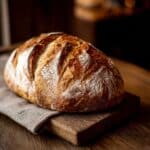
This Beginner Sourdough Bread recipe guides you through making an active sourdough starter and transforming it into a deliciously crusty and flavorful loaf. Designed for novice bakers, it covers essential steps like feeding the starter, mixing, fermenting, shaping, scoring, and baking in a Dutch oven to achieve the perfect artisan bread with a chewy crumb and golden crust.
- Prep Time: 12 hours (including starter fermentation), Active prep approx. 30 minutes
- Cook Time: 45-50 minutes
- Total Time: Approximately 13 hours (includes starter fermentation and dough rising times)
- Yield: 1 medium loaf (about 1 to 1.2 pounds / 450-550 grams bread) 1x
- Category: Bread
- Method: Baking
- Cuisine: American
Ingredients
Scale
Sourdough Starter Ingredients
- 2 teaspoons (10 g) active sourdough starter
- 3 tablespoons (25 g) all-purpose flour
- 5 teaspoons (25 g) water
Dough Ingredients
- ¼ cup (50 g) active sourdough starter (100% hydration)
- 1 ⅓ cups + 2 tablespoons (350 g) water
- 2 teaspoons (10 g) fine sea salt
- 4 cups + 2 tablespoons (500 g) bread flour
Instructions
- Feed your Sourdough Starter: About 12 hours before mixing your dough, combine 2 teaspoons sourdough starter, 3 tablespoons all-purpose flour, and 5 teaspoons water in a clean jar. Stir well, cover loosely, and leave at room temperature. The starter is ready when doubled in size with bubbles visible on the surface and jar sides.
- Mix the Dough: In a large bowl, mix 50 g active starter with 350 g water until evenly distributed. Add 500 g bread flour and 10 g sea salt. Mix with a stiff spatula or hands until a shaggy mass forms with no dry flour left.
- Rest the Dough: Cover bowl and let the dough rest at room temperature for 1 hour to start gluten development.
- Stretch and Fold #1: Moisten your hand and stretch one side of the dough over itself, rotating the bowl until a full circle of folds is completed. This tightens the dough. Cover and rest for 30 minutes.
- Stretch and Fold #2: Repeat the stretch and fold procedure again to build strength. Cover and allow the dough to bulk ferment on the counter for 7-10 hours, until it rises about 50-75% but does not double.
- Shape and Second Rise: Turn dough onto lightly floured surface. Shape into a ball by pulling sides into the middle, then flip seam-side down. Cup the dough, pulling and twisting to form a tight skin. Place dough seam-side down on parchment paper, lift and transfer into a medium-sized bowl. Cover and rest 1-2 hours at room temperature until nearly springy when indented.
- Preheat Oven and Dutch Oven: Half an hour before baking, preheat oven to 450°F (232°C) with Dutch oven inside to get thoroughly hot.
- Score and Bake: Using gloves, remove Dutch oven, take off lid. Score dough top with razor or sharp knife. Transfer dough with parchment paper into Dutch oven, cover with lid. Bake 20 minutes covered, then remove lid and bake additional 25-30 minutes until crust is golden brown and internal temperature reaches 205-210°F (96-99°C).
- Cool the Bread: Remove bread and set on a wire rack to cool for 1-2 hours before slicing to allow the crumb to set and prevent gummy texture.
- Store Properly: Store bread at room temperature wrapped in a bread bag or cloth, avoid refrigeration. For longer storage, freeze whole loaves or sliced portions tightly wrapped for up to 3 months.
- Serve: Enjoy warm with homemade butter, Nutella, or strawberry jam for the best flavor experience.
Notes
- The starter is made slightly more than needed because some adheres to jar sides during transfer.
- If the dough doubles in size or is hard to shape after bulk fermentation, it may be over-proofed; shorten rising time next bake.
- Use wet hands to prevent dough sticking during stretch and fold.
- Preheating the Dutch oven is essential for creating steam and a crispy crust.
- Letting the bread cool completely before slicing ensures ideal crumb texture.
- Do not refrigerate bread to maintain crust crispness and freshness.
Keywords: sourdough bread, beginner sourdough, homemade bread, artisan bread, Dutch oven bread, fermented bread
Find it online: https://zarameals.com/beginner-sourdough-bread-recipe/